

Maison Pierre Marcolini – premium belgian chocolates
Which Advent calendar should I choose?
How to choose a chocolate advent calendar: buyer's guide
A taste of what's ahead
- On paper, every calendar promises a daily countdown, but what actually decides the experience is what's waiting behind the card.
- Striking packaging catches the eye first, but it's the quality of the chocolate itself that the palate actually remembers.
- At Maison Pierre Marcolini, each door hides a chocolate surprise, made with pure cocoa butter and worked bean-to-bar in our own Brussels atelier.
Twenty-five little doors, twenty-five small acts of wonder. That's the promise of every chocolate advent calendar: open one a day, and December stops being a mere countdown to become a daily ritual of unannounced chocolate surprises.
Yet what waits behind those doors varies far more than the box lets on. Pay close attention to what the chocolate itself is made of, not only to how beautifully the casing sits on a shelf. Both matter to the experience. Only one of them is usually hidden.
At Maison Pierre Marcolini, we believe choosing a chocolate advent calendar with a little curiosity is what turns a month of waiting into a daily rediscovery.
What actually makes a chocolate advent calendar worth eating
Real cocoa butter, worked properly from bean to praline: that's what actually separates a calendar worth the daily ritual from one that only looks the part. Plenty of mass-market calendars swap it for cheaper vegetable fat to survive weeks in storage, at the cost of any real flavour.
At Maison Pierre Marcolini, that trade-off was refused outright. When European regulations first allowed it in 2001, Pierre Marcolini chose instead to keep producing his own chocolate from the bean, the same bean-to-bar craftsmanship that still shapes every collection today.
Open a door on the Maison's advent calendar, and what melts on the tongue is proper couverture chocolate, with the same snap and depth as anything else in the range.
Types of chocolate advent calendars, at a glance
From the outside, most chocolate advent calendars look remarkably alike. What's inside tends to fall into one of four families.
| Format | What to expect |
| Window or door calendar | The classic cardboard format, usually mass-produced and filled with compound chocolate shaped into simple figures |
| Box-style calendar | Individual compartments holding a genuinely varied selection, pralines, truffles, ganaches, rather than one shape repeated twenty-five times |
| Collector or designer calendar | The box itself is part of the appeal, built to be kept or displayed rather than recycled on 25 December |
| Build-your-own calendar | Less common: you fill the compartments yourself from a shop's existing range |
Maison Pierre Marcolini's advent calendar sits in the second and third categories at once: a genuinely varied assortment, in a box designed to be worth keeping on the table through December.
Picking the right advent calendar for who's actually eating it
Not every calendar needs to be judged the same way. People buy them for different reasons.
For the daily family ritual
A child opening a door before school. A couple sharing one over morning coffee. When the point is that small daily moment, the quality of the chocolate matters less than the ritual itself. Almost any well-made calendar does the job here.
For the chocolate lover treating themselves
Someone who already has opinions about chocolate notices the difference between a proper ganache and a filler straight away. A calendar filled with compound chocolate reads as a missed opportunity, not a treat. This is where cocoa quality actually shows.
For gifting
An advent calendar makes an easy, low-stakes gift, for a colleague, a friend, or someone you don't know terribly well. Presentation carries real weight here. A calendar that looks considered on the outside says something before the first door has even opened.
Maison Pierre Marcolini's calendar works for all three, but it's built with the second in mind first: the chocolate has to hold up on its own, ritual or not.
What to check before you buy an advent calendar
A short checklist, for whichever calendar you end up choosing:
- What the chocolate is actually made of. Look for "couverture" or a stated cocoa percentage rather than just "chocolate": it's usually the giveaway for compound fillers.
- How varied the contents are. Twenty-five of the same shape gets tiresome by day four. A proper mix of pralines, truffles and ganaches keeps the surprise alive all the way to Christmas Eve.
- The packaging. Cardboard and recyclable materials tend to age far better on a shelf than a calendar wrapped in plastic.
- The best-before date. If you're buying early, check how long the chocolates are meant to keep, so day twenty-five tastes as good as day one.
Our pick: the Christmas in the kitchen advent calendar
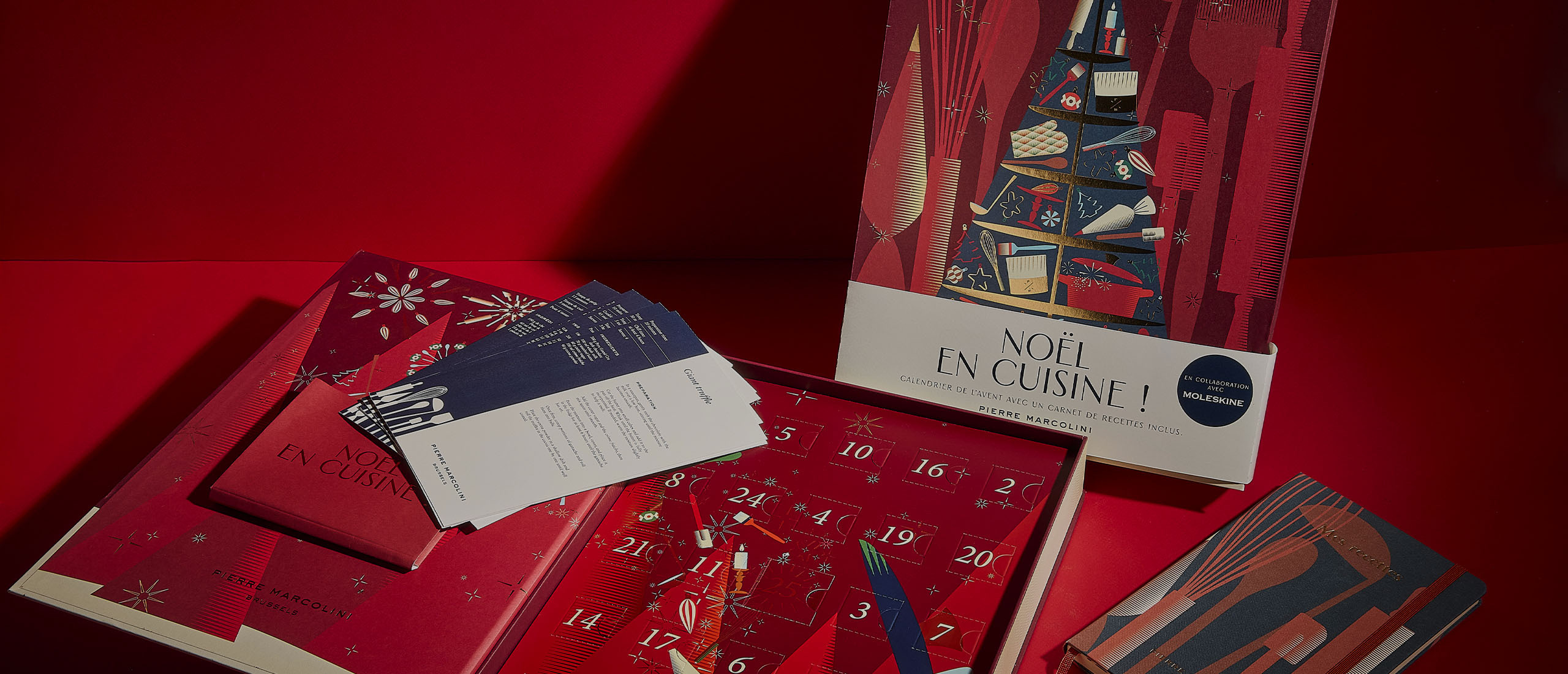
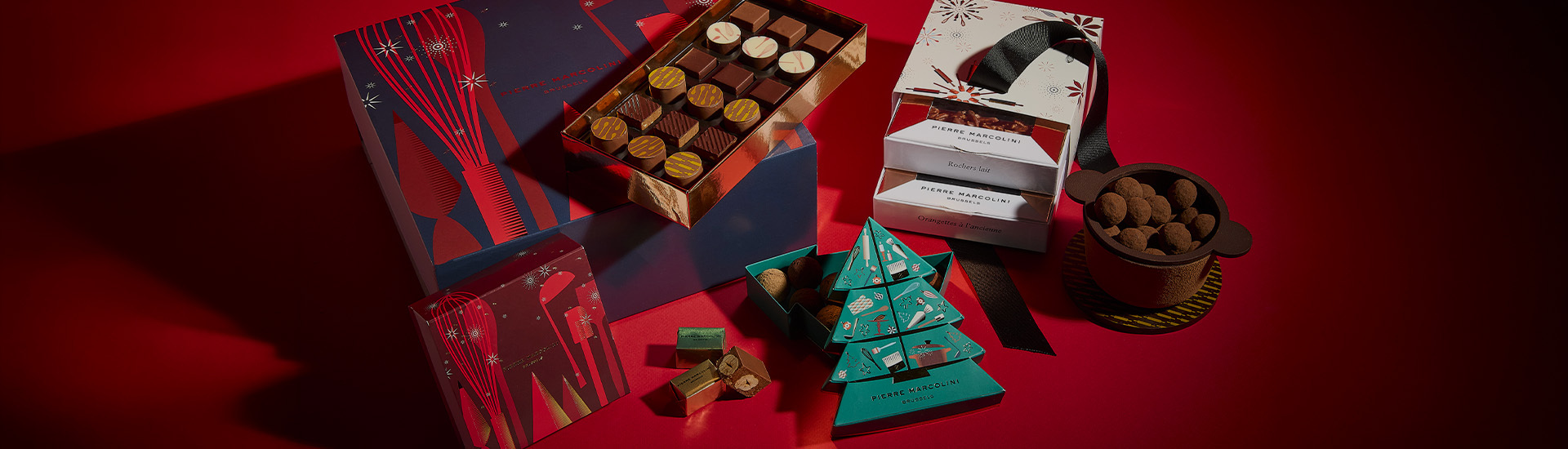
The Christmas in the Kitchen advent calendar is Maison Pierre Marcolini's own answer to the question: real chocolate, real variety, a box worth keeping.
Our calendar has twenty-five compartments, so the pleasure lasts right up to Christmas Day itself. Behind them is a genuine mix of pralines, cocoa truffles, melting fruit-filled hearts and Petits Bonheurs. Some are revisited classics, others bolder pairings such as yuzu, Sichuan pepper or cinnamon. Two creations were made just for this edition: a pistachio marzipan and a silky marshmallow. Every piece is worked with the same bean-to-bar chocolate as the rest of the range.
The box is shaped like a recipe book, with beige page edges and a book-style binding. It looks as much at home under the tree as on a kitchen shelf. Inside, Pierre Marcolini shares his own recipes, from his chocolate mousse to his hot chocolate, so the ritual carries on long after the last door.
For those who cook as much as they taste, a very limited edition of the advent calendar created with Moleskine pairs the same twenty-five surprises with an exclusive recipe notebook. It comes in the colours of the festive collection and is made to keep Pierre Marcolini's recipes alongside your own.
| Discover our chocolate advent calendar | Take a closer look at the calendar, and make it yours for this December. | >> Our chocolate advent calendar |
Frequently asked questions about chocolate advent calendars
When should you buy a chocolate advent calendar?
Most chocolate advent calendars appear in shops from October onwards, and the better-made ones tend to sell out weeks before December even starts. As a rule, ordering as soon as one catches your eye is a safer bet than waiting for the last minute.
Can I choose the content of the calendar?
No, the assortment inside is curated by the Maison rather than customisable. That's part of the format: the surprise of not knowing which chocolate is behind the next door is as much the point as the chocolate itself.
Can I reserve an advent calendar?
Yes. When a calendar is out of stock, you can register your email address on the product page to be notified as soon as it's available again, which is worth doing early given how quickly the collection tends to sell out.
If I buy the advent calendar now, will the chocolates still be fresh until December?
It depends on when you buy. Maison Pierre Marcolini's chocolates are best enjoyed within a few months of purchase, so a calendar bought in October or November will still be perfectly fresh by the time you open the first door. If you're buying well ahead of the season, it's worth checking the best-before date on the box rather than assuming, since freshness is exactly what sets a proper chocolate calendar apart from one built to survive a warehouse.
Your search
{{searchStr}}
({{products.length}} Result)
({{products.length}} Results)
Filters
Filters






Your search
{{searchStr}} (0 result)
No results were found for your search
A few tips to help you:
- Be more generic, you can then filter the results.
- Check the spelling of the entered words.
- If you are looking for a product from the catalogue, type its reference directly (ex: 15452)
- If you still cannot find your product, do not hesitate to contact us or visit our nearest store.
loading